 Image 1 of 1
Artist: Mikel Chaussepied, FRANCE
Media: Engraving
Edition: unknown
Image Size: 1 3/4" x 2 7/8"
Description:
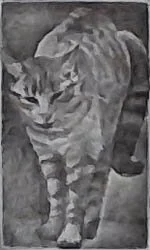
A lovely striped cat arching his back.
Born in October 1936 in Quimper into a family of architects, Mikel Chaussepied began his artistic studies between 1955 and 1958 at School of Fine Arts and Applied Arts of Cornouaille, which was later succeeded by the current European School of Art of Brittany. He continued his studies at the Regional School of Fine Arts in Rennes, presenting as his "regional culture thesis" a study in twenty lithographs of a canning factory in Kérity-Penmarc’h, and obtained his national diploma in Paris in 1960.
He began exhibiting as a painter in 1963 in Quimper. This first exhibition was followed by many others, both solo and group shows, in Nantes, Brest, Lorient, Rennes, and Paris. Having learned intaglio under Roland Sénéca in 1972, he soon began to exhibit engravings. In 1981, Soïchi Hasegawa invited him to exhibit at the Salon of Young Contemporary Engraving in Paris.
Apart from his lithographs created at the École des Beaux-Arts in Rennes and, more recently, ventures into relief etching, Mikel Chaussepied is primarily an intaglio printmaker who practices and combines etching, aquatint, and drypoint. His work is not exclusively Breton: it also reflects the curiosity of this traveling artist for Ireland (The Slea Head Wreck, Ireland), the English Cornwall (Boscastle, Cornwall), Australia (The Lightning-Struck Tree; The Swans of the Coorong), Patagonia (On the Patagonian Canals), Canada, the Seychelles (The Villa of the Seychelles)... Finistère, however, remains the most frequent setting, and within this department, a few favorite locations: the island of Molène, the Elorn River, as seen from his window in Le Relecq-Kerhuon, or the Cap Sizun, etc.
A figurative artist, attentive to landscapes both natural and shaped by humans, Mikel is a distant heir of the 'view artists' who roamed the French departments in the first half of the 19th century to record their various aspects during "picturesque and romantic journeys." He shares their fascination – also that of Henri Rivière – for the geological wonders of the Crozon Peninsula or the Cape. He is their successor and updates their perspective, for example when he engraves a particular aspect of Brest following its reconstruction.
Edition number EA
Artist: Mikel Chaussepied, FRANCE
Media: Engraving
Edition: unknown
Image Size: 1 3/4" x 2 7/8"
Description:
A lovely striped cat arching his back.
Born in October 1936 in Quimper into a family of architects, Mikel Chaussepied began his artistic studies between 1955 and 1958 at School of Fine Arts and Applied Arts of Cornouaille, which was later succeeded by the current European School of Art of Brittany. He continued his studies at the Regional School of Fine Arts in Rennes, presenting as his "regional culture thesis" a study in twenty lithographs of a canning factory in Kérity-Penmarc’h, and obtained his national diploma in Paris in 1960.
He began exhibiting as a painter in 1963 in Quimper. This first exhibition was followed by many others, both solo and group shows, in Nantes, Brest, Lorient, Rennes, and Paris. Having learned intaglio under Roland Sénéca in 1972, he soon began to exhibit engravings. In 1981, Soïchi Hasegawa invited him to exhibit at the Salon of Young Contemporary Engraving in Paris.
Apart from his lithographs created at the École des Beaux-Arts in Rennes and, more recently, ventures into relief etching, Mikel Chaussepied is primarily an intaglio printmaker who practices and combines etching, aquatint, and drypoint. His work is not exclusively Breton: it also reflects the curiosity of this traveling artist for Ireland (The Slea Head Wreck, Ireland), the English Cornwall (Boscastle, Cornwall), Australia (The Lightning-Struck Tree; The Swans of the Coorong), Patagonia (On the Patagonian Canals), Canada, the Seychelles (The Villa of the Seychelles)... Finistère, however, remains the most frequent setting, and within this department, a few favorite locations: the island of Molène, the Elorn River, as seen from his window in Le Relecq-Kerhuon, or the Cap Sizun, etc.
A figurative artist, attentive to landscapes both natural and shaped by humans, Mikel is a distant heir of the 'view artists' who roamed the French departments in the first half of the 19th century to record their various aspects during "picturesque and romantic journeys." He shares their fascination – also that of Henri Rivière – for the geological wonders of the Crozon Peninsula or the Cape. He is their successor and updates their perspective, for example when he engraves a particular aspect of Brest following its reconstruction.
Edition number EA